3D animation and Graphics
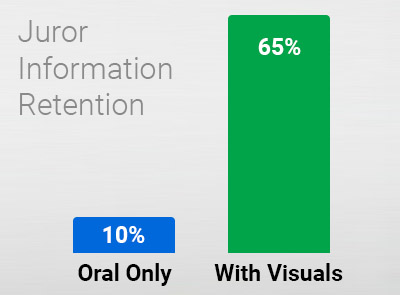
3D animation is extremely persuasive for both juries and judges. It can easily illustrate complex events that would otherwise be difficult to explain. More importantly, it significantly boosts juror recall of information and the overall persuasiveness of the evidence. One widely cited study found that combining oral arguments with visual aids increased retention of the facts by 650 percent. [1]
Research on how people retain information shows that oral arguments paired with visual aids make a huge difference. Jurors typically remember only about 10 percent of what they hear after a few days. When the same information is presented with clear visuals, retention often jumps to around 65 percent, that is more than a sixfold increase.[2]
This is not just about memory. Animation also makes a strong difference in verdicts. In several mock jury studies, adding animation roughly doubled the chance of a favorable outcome compared with testimony alone or with simple drawings. For instance, one study saw favorable verdicts rise from about 20–25 percent to 51 percent. In real terms, if your case has a 30 percent chance of success with a standard presentation, a well-made animation can meaningfully improve those odds.[3]
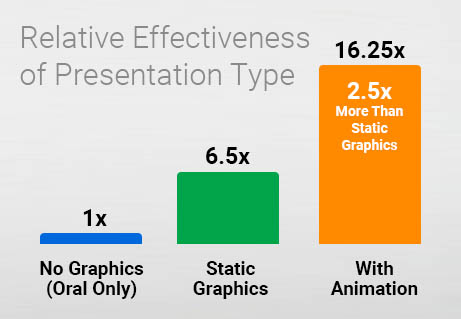
Animation also works better than static pictures or diagrams when motion, timing, or spatial awareness matters. Studies show it can lead to much higher understanding, often 2X to 3X better because people grasp moving events more easily than trying to imagine them from still images.[4] So while PowerPoint graphics may seem sufficient animation is actually the gold standard.
Mental Effort
The power of animation comes from how it works with spoken explanation. Together, they help the brain store both the facts and the conclusions in a way that is much easier to recall later. This reduces the mental effort jurors need to remember and understand the evidence.
In the jury room during deliberations, this means your arguments stay clearer and easier to remember. Without animation, jurors often struggle to recall details and must work harder to reach conclusions. A good 3D animation lets you directly show why your position is correct, helping jurors form strong opinions they can easily bring up and defend later.[5]
Interactive 3D Exhibits
At Fluid Media Studios, LLC we take this understanding and maximize it with our 3D interactive animated exhibits. These build on all the benefits of traditional 3D animation but allow the attorney/expert to engage the evidence with the jury dynamically in real time, much like educational games and simulations that research shows lead to stronger engagement, deeper understanding, and better long-term recall.[6] You can link related documents, videos, and photos directly into the interactive model at the exact points they matter. This keeps the jury focused and involved even when reviewing detailed materials, turning passive listening into active exploration.
We have spent more than 20 years creating high-quality 3D animations for the courtroom. We have worked on hundreds of cases and earned multiple awards for our work. Strong 3D animations can help win cases when done right. We go further by delivering accurate, compelling visuals that stand up to challenges and outperform the competition in court.
References
[1] Kassin, S. M., & Dunn, M. A. (1997). Computer-animated displays and the jury: Facilitative and prejudicial effects. Law and Human Behavior, 21(3), 269–281.
[2] Weiss-McGrath Report (commonly cited multimedia retention data, referenced in litigation graphics research since the early 1990s).
[3] Rempel, J., & Burke, A. (2022). Computer-generated animation in the courtroom: Effects on mock juror decision making. Psychology, Crime & Law.
[4] Ploetzner, R., et al. (2021). When learning from animations is more successful than learning from static pictures: Learning the specifics of change. Instructional Science.
[5] Mayer, R. E. (2009). Multimedia Learning (2nd ed.). Cambridge University Press.
[6] Vogel, J. J., Vogel, D. S., Cannon-Bowers, J., Bowers, C. A., Muse, K., & Wright, M. (2006). Computer gaming and interactive simulations for learning: A meta-analysis. Journal of Educational Computing Research, 34(3), 229–243.
